The Star Trek Report chronicles the history of mankind's attempt to reach the stars, from the fiction that gave birth to the dreams, to the real-life heroes who have turned those dreams into reality.


Monday, July 9, 2012

NASA Mars Program Offical Discusses New Era Of Space Exploration

From Space Ref:  NASA Mars Program Offical Discusses New Era Of Space Exploration

Media representatives are invited to a briefing on Tuesday, July 10 at 9 a.m. BST at the 2012 Farnborough International Airshow in Farnborough, England. NASA and industry officials will discuss the importance of the space program and the role of cost-efficient product development in the emerging new era of space travel and exploration.

Doug McCuistion, director of NASA's Mars Exploration Program at NASA Headquarters, Washington, and Siegfried Russwurm, CEO of Siemens Industry Sector, Erlangen, Germany, will provide details and answer questions about the importance of government and industry collaboration to maximize productivity and efficiency in space exploration. The briefing will take place the Hendon Room in the airshow's media center.

Siemens software contributed to the development of NASA's most advanced planetary rover, Curiosity, which will land on the surface of Mars on Aug. 6 at 1:31 a.m. EDT. This mobile science laboratory will assess whether the past or present Martian environment could support life. The software was used for modeling during development of the rover.

Media representatives attending the air show that would like to participate in the briefing should register online at: https://www.industry-meeting.com/event/microsite/22/sign-up/

The Farnborough International Airshow is an annual event featuring a host of activities, exhibits, and static and aerial demonstrations by aerospace companies worldwide.

For information about NASA's Curiosity rover, visit: http://www.nasa.gov/msl


Friday, July 6, 2012

CHENG: China’s space challenge to America

From WAshington Times, op ed piece:  CHENG: China’s space challenge to America

ANALYSIS/OPINION:
At the dawn of the Space Age, China lagged far behind the United States and the Soviet Union. Beijing didn’t even launch its first satellite until 1970.

But China has made remarkable progress. On June 24, three Chinese astronauts successfully docked their Shenzhou spacecraft with the orbiting Tiangong-1 space lab. The mission underscored again China’s interest in manned spaceflight. And the manual docking itself marked a major step toward a greater Chinese presence in space, as docking and extended missions are essential to any space station or lunar mission.
China’s manned space program results from longstanding indigenous development efforts, leavened with some foreign technology. Aerospace efforts have been a top research priority for the People's Republic of China since March 1986. That’s when senior political and military leadership established Plan 863, formally termed the National High-Technology Research and Development Plan. These leaders saw space capability as promoting economic development. Moreover, many viewed space as an arena where competition with the United States would be both inevitable and necessary.

With commitment from the top, progress was rapid. By 1990, Chinese scientists approved a space-capsule design that would serve as China’s vessel to the stars.

China’s space efforts also got a boost with the collapse of the Soviet Union. Cash-strapped Russia happily sold China life-support systems and spacesuit technology. The Kremlin also trained two Chinese astronauts - all for cash.

China took the Russian technology and improved upon it. The Chinese Shenzhou spacecraft is more powerful and versatile than its Soyuz cousin. Similarly, the Tiangong-1 space lab bears little resemblance to the Soviet Salyut space station - not least because the Chinese program isn’t armed with a cannon.
Beijing has used its space program, including its manned space efforts, to highlight its technological prowess and to build diplomatic bridges. But the program also serves to signal the PRC’s growing military capabilities, and to raise its stature as a great power.

Compared to China, the United States enjoys a far wider array of space capabilities, but Washington seems to employ them less effectively. Here are some things the U.S. can do to get the most out of its space programs.
*Think about space in broader terms. China sees space not just as an arena for industrial policy, but as a diplomatic tool. Every Chinese space mission is a form of strategic communications. NASA’s products are a de facto refutation of claims of American decline, and should be used as such. U.S. space achievements such as the return of the X-37B or the departure of the Voyager spacecraft from the solar system (marking the farthest distance any man-made object has ever traveled) should be far more publicized worldwide.

*Rely on American strengths. A few weeks before the Shenzhou mission, a Dragon spacecraft - operated by SpaceX Corp. - resupplied the International Space Station. It was the first commercial spacecraft to dock with the ISS. The United States should encourage the commercial sector, ever intent on reducing costs, to play a greater role. Space exploration arguably requires the government; the business of space exploitation, whether resupplying the ISS or promoting space tourism, does not.

*Be cautious in engaging in space cooperation and interaction. Many Americans embrace the idea of international cooperation in space, especially when it comes to manned missions. But China’s emphasis on indigenous development suggests that Beijing will focus more on political than budgetary burden-sharing. It also suggests that China will pursue technological “cooperation” that favors itself in any joint space ventures, such as demanding establishment of R&D facilities in China and preferential transfers of technology. Equally important, Chinese interest in legal warfare should make the U.S. wary of creating new international covenants or codes of conduct regarding space. Beijing may well try to use such instruments to constrain American efforts to prepare for potential space conflicts. Cooperation needs to be mutually beneficial.

The late-arriving entry from the Far East must be taken as a serious - and tough - player in the international competition to tame “the final frontier.”
Dean Cheng is a research fellow in the Heritage Foundation’s Asian Studies Center.


Tuesday, July 3, 2012

Bill Nye fears U.S. space exploration in jeopardy over budget cuts

From Examiner.com:  Bill Nye fears U.S. space exploration in jeopardy over budget cuts

Recently, Bill Nye, the "Science Guy" shared his fears that U.S. space exploration could be in jeopardy if the Obama administration cuts NASA's budget any deeper. Nye says that global warming and an asteroid impact, among other things, could be thwarted if funds continue pouring in.

In a CNN report on July 2, Nye shared his opinions about Obama's planned cuts of $300 million from NASA's planetary exploration budget. As the head of the Planetary Society, he has become one of the leading opponents of the measure.
"This is a deep, deep concern. All the budgets are being cut. We gotcha, budgets are being cut, budgets are being pulled back, yes, yes, all good.
"But investment in space stimulates society, it stimulates it economically, it stimulates it intellectually, and it gives us all passion. Everyone, red state, blue state, everyone supports space exploration. So I understand the budget has got to be cut, but something has gone a little bit wrong."

Bill Nye also said if the United States cuts back on NASA's space exploration budget, the world faces two preventable events, global warming or climate change and the threat of an asteroid impact.

He believes that more can be learned by sending astronauts up into space to study the impact man-made emissions have on the planet from afar. Often times, clues about how the Earth is changing can be studied from technologies like those used in the International Space Station.

What's more, the "Science Guy" believes that continued funding allows NASA to develop ways to prevent the annihilation of civilization from a large asteroid impact.

"If the Earth gets hit by an asteroid, it's game over. It's control-alt-delete for civilization. So what we want to do is to develop the capability to redirect, to deflect an asteroid, ever so slightly. If you're going to do that, you've got to have space exploration," Nye added.

Is Bill Nye correct about U.S. space exploration losing its dominance if NASA suffers further cuts from the Obama administration?


Monday, July 2, 2012

First female taikonaut: 'It's good to stand on Earth'

From New Scientist:  First female taikonaut: 'It's good to stand on Earth'

rexfeatures_1776241j.jpg 
(Image: KeystoneUSA-ZUMA/Rex Features)

Liu Yang, the first Chinese woman in space, returned to Earth today as the Shenzhou-9 spacecraft landed safely in Inner Mongolia at 10:05 local time (02:05 GMT). The descent was slowed by parachutes, as well as rockets which fired when the capsule was 1 metre above the ground, slowing the capsule to a touchdown speed of 3.5 metres per second. Upon exiting the Shenzhou-9 capsule, Liu said "It feels so good to stand on Earth, and it feels even better to be home".

Liu and her colleagues, Jing Haipeng and Liu Wang, were returning from the first crewed mission to the Chinese space station, Tiangong-1, meaning "Heavenly Place". As part of their 13-day mission, the trio spent several days aboard the station, during which time they conducted a number of experiments and performed technical demonstrations required for the creation of a larger space station.

The Chinese space agency aims to use the knowledge gained during this mission to help it assemble a larger, modular space station over the next decade. A second crewed flight, Shenzhou-10, is planned for next year before China delivers its more sophisticated Tiangong-2 module to orbit. Subsequent modules will then follow. The completed station is expected to be similar in size to the now-defunct US space station Skylab, which is roughly a sixth of the size of the International Space Station.


NASA 's Super Guppy delivers space shuttle trainer to the Museum of Flight

From the Seattle Times:  NASA 's Super Guppy delivers space shuttle trainer to the Museum of Flight


ALAN BERNER / THE SEATTLE TIMES
A crew member of the Super Guppy cargo plane leans from the cockpit window as the plane is hooked to a tug outside the Museum of Flight Saturday, delivering part of the NASA space shuttle trainer.

BETTINA HANSEN / THE SEATTLE TIMES
NASA's Super Guppy aircraft, carrying crew compartment of the space shuttle trainer, makes a flyover around downtown Seattle on its way to The Museum of Flight.

ALAN BERNER / THE SEATTLE TIMES
The Super Guppy delivers plenty of cargo and decibels as it arrives at the Museum of Flight Saturday.

ALAN BERNER / THE SEATTLE TIMES
The front part of the Super Guppy cargo plane is cracked open as it swings forward 90-degrees so the space shuttle trainer can be unloaded Saturday.

ALAN BERNER / THE SEATTLE TIMES
The front part of the shrink-wrapped Space Shuttle trainer is moved on a specialty vehicle with the Super Guppy in the background, its cargo bay and cockpit area at a 90-degree angle at Boeing Field. The vehicle moving the trainer part was brought up from JBLM to assist.
ALAN BERNER / THE SEATTLE TIMES
Raw video: NASA's Super Guppy cargo plane delivers the space shuttle trainer to the Museum of Flight Saturday, June 30, 2012.

ALAN BERNER / THE SEATTLE TIMES
Ted Huetter from the Museum of Flight is an astronaut for the day, dressed like the 355 who flew in the Space Shuttle. His suit was made for the museum and is a replica of the real ones.


Sunday, July 1, 2012

Getting Star Trek on the air was impossible

From the Letters of Note Blog

Getting Star Trek on the air was impossible


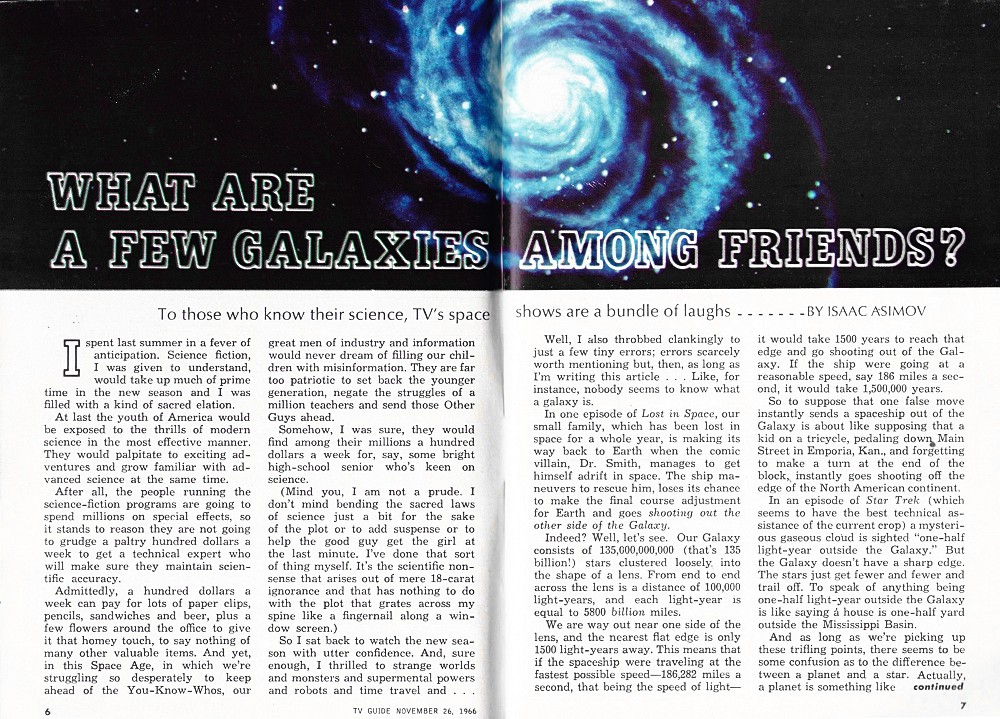
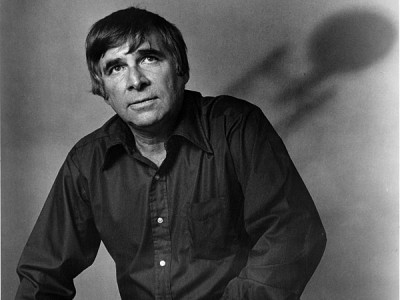
In November of 1966, two months after the first Star Trek series premièred in the U.S., science fiction author Isaac Asimov wrote an article for TV Guide in which he complained about the numerous scientific inaccuracies found in science fiction TV shows of the day — Star Trek included. That show's creator, Gene Roddenberry, didn't take kindly to the jab, and immediately wrote to Asimov with a polite but stern response that also went some way to explaining the difficulties of bringing such a show to the screen. His letter can be read below.

Asimov apologised, and in fact became a good friend of Roddenberry's and an advisor to the show. Also below is a fascinating exchange of theirs that took place some months later, just as a problem arose relating to the relationship between Captain Kirk and Spock — a potentially damaging problem that Asimov helped to solve.

(Source: Star Trek Creator: The Authorized Biography of Gene Roddenberry; Images of Gene Roddenberry & Isaac Asimov via here & here.)

29 November, 1966

Dear Isaac:

Sorry I had to address it in this round-about way since I did not have your address and Harlan Ellison, who might have supplied it, is working a final draft for us and is already a week late and I don't want to take his attention away from it for even a moment. On second thought, I believe he is a month or two late.

Wanted to comment on your TV Guide article, "What Are A Few Galaxies Among Friends?"

Enjoyed it as I enjoy all your writing. And it will serve as a handy reference to those of our Star Trek writers who do not have a SF background. Although, to be perfectly honest, those with SF background and experience tend to make the same mistakes. I've found that the best SF writing is no guarantee of science accuracy.

A person should get his facts straight when writing anything. So, as much as I enjoyed your article, I am haunted by this need to write you with the suggestion that some of your facts were not straight. And, just as a writer writing about science should know what a galaxy is, a writer writing about television has an obligation to acquaint himself with pertinent aspects of that field. In all friendliness, and with sincere thanks for the hundreds of wonderful hours of reading you have given me, it does seem to me that your article overlooked entirely the practical, factual and scientific problems involved in getting a television show on the air and keeping it there. Television deserved much criticism, not just SF alone but all of it, but that criticism should be aimed, not shot-gunned. For example, Star Trek almost did not get on the air because it refused to do a juvenile science fiction, because it refused to put a "Lassie" aboard the space ship, and because it insisted on hiring Dick Matheson, Harlan Ellison, A.E. Van Vogt, Phil Farmer, and so on. (Not all of these came through since TV scripting is a highly difficult specialty, but many of them did.)

In the specific comment you made about Star Trek, the mysterious cloud being "one-half light-year outside the Galaxy," I agree certainly that this was stated badly, but on the other hand, it got past a Rand Corporation physicist who is hired by us to review all of our stories and scripts, and further, got past Kellum deForest Research who is also hired to do the same job.

And, needless to say, it got past me.

We do spend several hundred dollars a week to guarantee scientific accuracy. And several hundred more dollars a week to guarantee other forms of accuracy, logical progressions, etc. Before going into production we made up a "Writer's Guide" covering many of these things and we send out new pages, amendments, lists of terminology, excerpts of science articles, etc., to our writers continually. And to our directors. And specific science information to our actors depending on the job they portray. For example, we are presently accumulating a file on space medicine for De Forest Kelly who plays the ship's surgeon aboard the USS Enterprise. William Shatner, playing Captain James Kirk, and Leonard Nimoy, playing Mr. Spock, spend much of their free time reading articles, clippings, SF stories, and other material we send them.

Despite all of this we do make mistakes and will probably continue to make them. The reason—Thursday has an annoying way of coming up once a week, and five working days an episode is a crushing burden, an impossible one. The wonder of it is not that we make mistakes, but that we are able to turn out once a week science fiction which is (if we are to believe SF writers and fans who are writing us in increasing numbers) the first true SF series ever made on television. We like to think this is what we are trying to do, and trying with considerable pride. And I suppose with considerable touchiness when we believe we are criticized unfairly or as in the case of your article, damned with faint praise. Quoting Ted Sturgeon who made his first script attempt with us (and now seems firmly established as a contributor to good television), getting Star Trek on the air was impossible, putting out a program like this on a TV budget is impossible, reaching the necessary mass audience without alienating the select SF audience is impossible, not succumbing to network pressure to "juvenilize" the show is impossible, keeping it on the air is impossible. We've done all of these things. Perhaps someone else could have done it better, but no one else did.

Again, if we are to believe our letters (now mounting into the thousands), we are reaching a vast number of people who never before understood SF or enjoyed it. We are, in fact, making fans—making future purchasers of SF magazines and novels, making future box office receipts for SF films. We are, I sincerely hope, making new purchasers of "The Foundation" novels, "I, Robot," "The Rest of the Robots," and other of your excellent work. We, and I personally, in our own way and beset with the strange problems of this mass communications media, work as proudly and as hard as any other SF writer in this land.

If mention was to be made of SF in television, we deserved much better. And, as much as I admire you in your work, I felt an obligation to reply.

And, I believe, the public deserves a more definitive article on all this. Perhaps TV Guide is not the marketplace for it, but if you ever care to throw the Asimov mind and wit toward a definitive TV piece, please count on us for facts, figures, sample budgets, practical production examples, and samples of scripts from rough story to the usual multitude of drafts, samples of mass media "pressure," and whatever else we can give you.

Sincerely yours,

Gene Roddenberry

-----------------------

[Seven months later...]

June, 1967

Dear Isaac,

Wish you were out here.

I would dearly love to discuss with you a problem about the show and the format. It concerns Captain James Kirk and of course the actor who plays that role, William Shatner. Bill is a fine actor, has been in leads on Broadway, has done excellent motion pictures, is generally rated as fine an actor as we have in this country. But we're not getting the use of him that we should and it is not his fault. It's easy to give good situations and good lines to Spock. And to a lesser extent the same rule is true of the irascible Dr. McCoy. I guess it's something like doing a scene with several businessmen in a room with an Eskimo. The interesting and amusing situations, the clever lines, would tend to go to the Eskimo. Or in our case, the Eskimos.

And yet Star Trek needs a strong lead, an Earth lead. Without diminishing the importance of the secondary continuing characters. But the problem we generally find is this—if we play Kirk as a true ship commander, strong and hard, devoted to career and service, it too often makes him seem unlikable. On the other hand, if we play him too warm-hearted, friendly and so on, the attitude often is "how did a guy like that get to be a ship commander?" Sort of a damned if he does and damned if he doesn't situation. Actually, although it is missed by the general audience, it is Kirk's fine handling of a most difficult role that permits Spock and the others to come off as well as they do. But Kirk does deserve more and so does the actor who plays him. I am in something of a quandary about it.

Got any ideas?

Gene

-----------------------

Gene,

In some way, this is the example of the general problems of first banana/second banana. The star has to be a well-rounded individual but the supporting player can be a "humorous" man in the Elizabethan sense. He can specialize. Since his role is smaller and less important, he can be made highly seasoned, and his peculiarities and humors can easily win a wide following simply because they are so marked and even predictable. The top banana is disregarded simply because he carries the show and must do many things in many ways. The proof of the pudding is that it is rare for a second banana to be able to support a show in his old character if he keeps that character. There are exceptions. Gomer Pyle made it as Gomer Pyle (and acquired a second banana of his own in the person of the sergeant.)

Undoubtedly, it is hard on the top banana (who like all actors has a healthy streak of insecurity and needs vocal and constant reassurance from the audience) to not feel drowned out. Everybody in the show knows exactly how important and how good Mr. Shatner is, and so do all the actors, including even Mr. Shatner. Still, when the fan letters go to Mr. Nimoy and articles like mine concentrate on him, one can't help feeling unappreciated.

What to do? Well, let me think about it and write another letter in a few days. I don't know that I'll have any magic solutions, but you know, some vagrant thought of mine might spark some thought in you and who knows.

Isaac

[A few weeks later...]

Gene,

I promised to get back to you with my thoughts on the question of Mr. Shatner and the dilemma of playing against such a fad-character as "Mr. Spock."

The more I think about it, the more I think the problem is psychological. That is, Star Trek is successful, and I think it will prove easier to get a renewal for the third year than was the case for the second. The chief practical reason for its success Mr. Spock. The excellence of the stories and the acting brings in the intelligent audience (who aren't enough in numbers, alas, to affect the ratings appreciably) but Mr. Spock brings in the "teenage vote" which does send the ratings over the top. Therefore, nothing can or should be done about that. (Besides, Mr. Spock is a wonderful character and I would be most reluctant to change him in any way.)

The problem, then, is how to convince the world, and Mr. Shatner, that Mr. Shatner is the lead.

It seems to me that the only thing one can do is lead from strength. Mr. Shatner is a versatile and talented actor and perhaps this should be made plain by giving him a chance at a variety of roles. In other words, an effort should be made to work up story plots in which Mr. Shatner has an opportunity to put on disguises or take over roles of unusual nature. A bravura display of his versatility would be impressive indeed and would probably make the whole deal a great deal more fun for Mr. Shatner. (He might also consider that a display of virtuosity would stand him in great stead when the time—the sad time—came that Star Trek had finished its run and he must look elsewhere.)

Then, too, it might be well to unify the team of Kirk and Spock a bit, by having them actively meet various menaces together with one saving the life of the other on occasion. The idea of this would be to get people to think of Kirk when they think of Spock.

And, finally, the most important suggestion of all—ignore this letter, unless it happens to make sense to you.

Isaac

-----------------------

Isaac,

Your comments on Shatner and Spock were most interesting and I have passed them on to Gene Coon and others. We've followed one idea immediately, that of having Spock save his Captain's life, in an up-coming show. I will follow your advice about having them much more a team, standing more closely together. As for having Shatner play more varied roles, we have been looking in that direction and will continue to do so.

But I think the most important comment is that of keeping them a close team. Shatner will come off ahead by showing he is fond of the teenage idol; Spock will do well by displaying great loyalty to his Captain.

In a way it will give us one lead, the team.

Gene

NASA Speculates It Found Life, Hidden Ocean on Saturn's Moon Titan

From Encino-Tanzana Patch:  NASA Speculates It Found Life, Hidden Ocean on Saturn's Moon Titan

Is it possible that NASA's Cassini spacecraft has found evidence of an ocean of water beneath the frozen crust of Saturn's largest moon called Titan?

A team of researchers' findings were reported and released online by the journal Science on Thursay that they "saw a large amount of squeezing and stretching as the moon orbited Saturn." These discoveries reveal that if Titan were made up of just mounds of stiff rock, the gravitational attraction of Saturn would cause bulges, or solid "tides," on the moon only 3 feet high.

"Cassini's detection of large tides on Titan leads to the almost inescapable conclusion that there is a hidden ocean at depth," said Luciano Iess, the lead author of the report and a Cassini team member at the Sapienza University of Rome, Italy in a news release issued by NASA. "The search for water is an important goal in solar system exploration, and now we've spotted another place where it is abundant."

It takes the Titan moon around 16 days to orbit Saturn, and the team was able to study the moon's shape at different parts of its orbit. "Because Titan is not spherical but slightly elongated like a football, its long axis grew when it was closer to Saturn. Eight days later, when Titan was farther from Saturn, it became less elongated and more nearly round," according to the NASA news release. Cassini measured the gravitational effect of that squeeze and pull.

Mystery of Saturn
Astrologer and author of several books, Donna Stellhorn who studies the planets, explained that Saturn's Moon, Titan, was discovered in 1655 by Dutch astronomer, Christiaan Huygens but he didn't name the moon Titan.

“He called it simply Saturn IV representing the fourth moon of Saturn. It was John Herschel in 1847 who named it Titan for the Titans of Greek mythology. What's most interesting about this name is many scholars believe the word Titan is related to the Greek verb meaning 'to stretch,'” she said.

“And here we're told that NASA made this fascinating discovery of Titan's buried ocean by watching Titan 'squeeze and stretch' in its orbit around Saturn.

“From an astrological point of view this discovery signals that we should be asking ourselves is: 'where do we need to stretch ourselves' to gain what we want?”

Stellhorn says Saturn is named after the Roman god Saturnus, it is also where we get the word, Saturday.
"But despite the joy of our modern day Saturday, Saturn has two sides; one of restriction and inhibition and the other of success and achievement," she said. "In astrology Saturn represents your career like in ancient times Saturnus ruled over agriculture (the first career of ancient people)."

Currently, Saturn is in Libra and it is considered exalted in Libra meaning that Saturn is very strong in this sign. Saturn in Libra brings our attention to partnerships and relationships where we test them to see if it's a partnership that will bring us what we want, Stellhorn says.

"Saturn in Libra brings us a strong sense of duty and obligation to others whether they be friends or the community at large (hence the passing of the Affordable Care Act)," she said. "But Saturn in Libra can also make us inhibited around others, we want to guard and protect ourselves from potential danger and ridicule."
Saturn will leave Libra around October 5 and as he leaves he will take something from each of us; a friendship or relationship may end, your career may shift, or an opportunity may escape you. But the void left from whatever Saturn takes will soon be filled with something much, much better, she said.

Incidentally, the NASA news release also says: "that an ocean layer does not have to be huge or deep to create these tides. A liquid layer between the external, deformable shell and a solid mantle would enable Titan to bulge and compress as it orbits Saturn."

Because Titan's surface is mostly made up of water ice, which is aplenty in moons of the outer solar system, scientists think: "Titan's ocean is likely mostly liquid water," according to the NASA news release.

"The presence of a subsurface layer of liquid water at Titan is not itself an indicator for life. Scientists think life is more likely to arise when liquid water is in contact with rock, and these measurements cannot tell whether the ocean bottom is made up of rock or ice. The results have a bigger implication for the mystery of methane replenishment on Titan," according to the NASA news release.